
Reviewed · DELFT
Rotterdam & Delft Private Offshore Daily Walking Tour
This is the kind of day tour that feels like two cities, stitched together by one theme: water and rebuilding. You start at modern Rotterdam icons and end in Delft’s old-town lanes, with a guide who keeps the pace human and the stops meaningful. I like how the route hits both the big photo spots and the smaller, “why does this exist?” buildings.
Two things I especially like: first, the private group of up to 4, which makes it easier to slow down, ask questions, and adjust on the spot. Second, the mix of Rotterdam engineering and Delft heritage, from the Erasmus Bridge and De Hef to Delft churches, archives, and Royal Delft ceramics. It is not just sightseeing, it is city logic.
One drawback to plan for: several interiors have separate entry fees (and public transport is not included). Also, it is a full 7.5-hour walk day, so you will want comfortable shoes and a little patience for weather, wind, and crowds around the photo heavy spots.
Key highlights worth your attention

- Private attention for up to 4 people, with guide Alex adjusting for interests and mobility needs
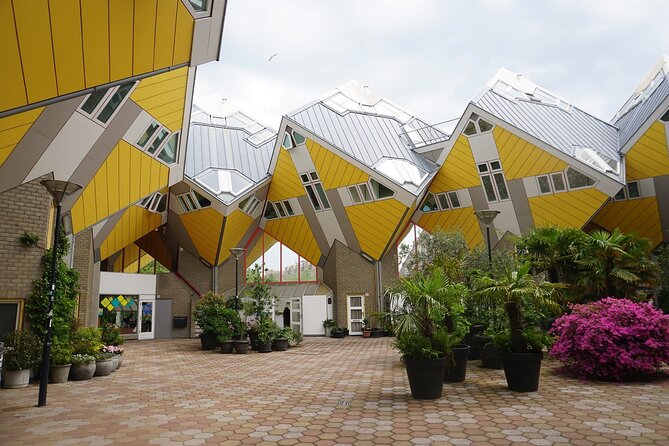
- Cube Houses (Kijk-Kubus) entry is included, so you can go inside rather than just look
- Rotterdam survival stories, including churches and landmark buildings impacted by bombing in 1940
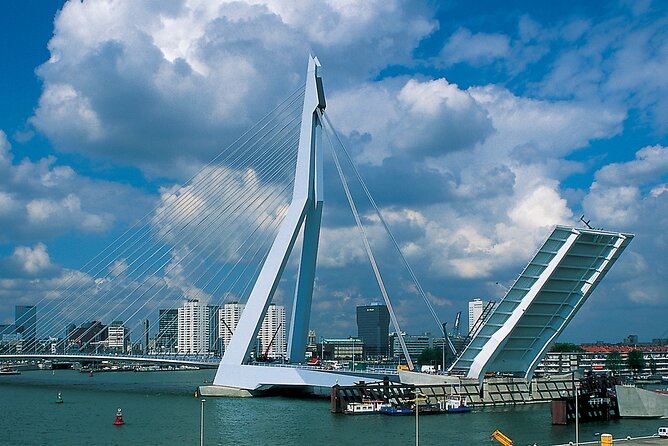
- Engineering icons on Nieuwe Maas, like De Hef and the Erasmus Bridge with its huge 80 m opening span
- Delft “Blue” culture stops, including Delft railway station design and Royal Delft pottery
- Coffee and/or tea included, timed within or after the tour to keep energy steady
Why Rotterdam to Delft makes such a satisfying full-day combo
You get a rare comparison day. Rotterdam is the city that rebuilt fast and big, and Delft is the calmer, older cousin that grew into Dutch culture and craft. Walking this line helps you understand why each city looks the way it does. You see modern stations and bridges set against medieval churches, and you start noticing patterns: water management, trade, and the way cities protect their identity even after disruption.
This tour also leans practical. You are not stuck on a one-size-fits-all script. The guide listed in the experience, Alex, is known for being friendly, adjusting the day based on what your group cares about, and even handling real-life problems with serious follow-through. That matters more than people think when you have luggage mix-ups, mobility constraints, or just a group that needs a slower rhythm.
More Walking Tours in Rotterdam
- Rotterdam: Architectural Highlights Guided Walking Tour
★ 4.8 · 215 reviews - Rotterdam: Highlights, Gems, Architecture & History Walk
★ 5.0 · 191 reviews - Rotterdam Walk: Hilights, Gems, Architecture & WWII | 2 or 3hrs
★ 5.0 · 149 reviews
Price and value: what $5,683.71 per group really buys
The price is $5,683.71 per group (up to 4) for about 7 hours 30 minutes. If you split it four ways, you are roughly in the $1,400 range per person. That is not cheap, but it is private, and it covers a lot of “time saved” and “help unlocked.”
Where the value shows up:
- You get a guide for the entire day, not just a couple of stops.
- You get pickup in Rotterdam or Delft, so you are not spending half your morning figuring out meeting points.
- You get Cube Houses admission included, which is one of those sights that is worth paying for because it is a full experience, not just a quick glance.
- You also get coffee and/or tea included, which is a small cost in normal life but a nice day saver when you are on the move.
If you are traveling solo or as a couple, the per-person number will feel higher. But if you have a family, two friends, or you want a low-stress day with minimal logistics, private can actually be the most efficient choice.
Pickup, meeting point, and how to avoid wasting the first hour
The meeting point is the Port of Rotterdam, Wilhelminakade 909, 3072 AP Rotterdam. The tour ends back at the meeting point, so you are not guessing where to land after a long day.
Pickup is available in any hotel in Rotterdam or Delft. If you are coming from Amsterdam, the experience notes that Amsterdam can be considered as a departure point by agreement, including options like Amsterdam Passenger Terminal or Amsterdam Central Station. This matters because getting to Rotterdam can be the hardest part of a day like this, especially if your timing is tied to cruise schedules or flight arrivals.
One more practical note: the tour is marked as mobile ticket and offered in English, with the schedule running Monday through Sunday, 9:00 AM to 6:00 PM in the stated date window.
Rotterdam Centraal Station: modern architecture and instant orientation
You start at Rotterdam Centraal Station, the main railway station of Rotterdam with an average of 170,000 passengers daily. This is not a “sit and admire it” stop. It is a quick way to understand the city’s scale and motion. Rotterdam is built around movement, and the station’s modern design makes that feel real.
What to watch for here:
- How the station signals a city that expects constant flow.
- The way it connects you to the rest of the area, so later landmarks make more sense.
It is also a smart early stop because it helps you get bearings fast before you shift from transit energy to architectural stories.
More of Delft:
- Kinderdijk Windmills, Delft City & Delft Blue Factory Visit
★ 5.0 · 5 reviews - From Amsterdam: Rotterdam, Delft & The Hague Guided Day Tour
★ 4.2 · 2,065 reviews - Rotterdam, Delft and The Hague Day Trip from Amsterdam
★ 4.0 · 892 reviews - Rotterdam, Delft and The Hague Small Group Tour from Amsterdam
★ 4.5 · 599 reviews
Water management and the 1940 survivors you will notice all day
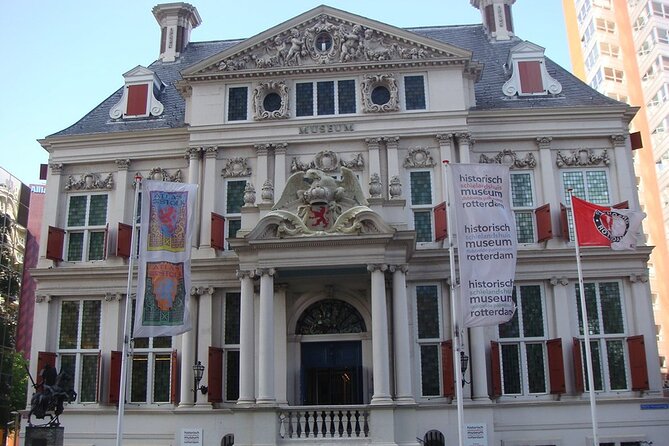
Next up is Hoogheemraadschap Schieland and Krimpenerwaard, a 17th-century building that used to be tied to water policy and management. It is also noted as temporary accommodation for Napoleon Bonaparte, which is a detail that helps you picture how long this region’s systems have mattered.
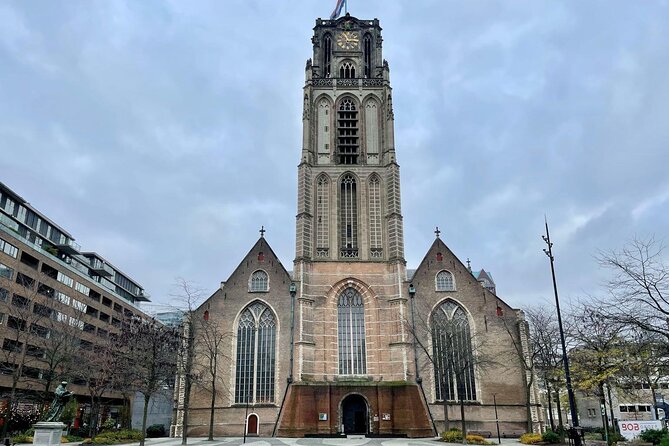
From there, you reach Grote of Sint-Laurenskerk, a late Gothic church from 1525. The key point is that it survived the Nazi bombing on May 15, 1940. Even without going inside, you will walk past it with a different lens. Rotterdam’s identity is not just about new construction. It is also about what was damaged and what endured.
Erasmus Monument and the Markthal mood shift
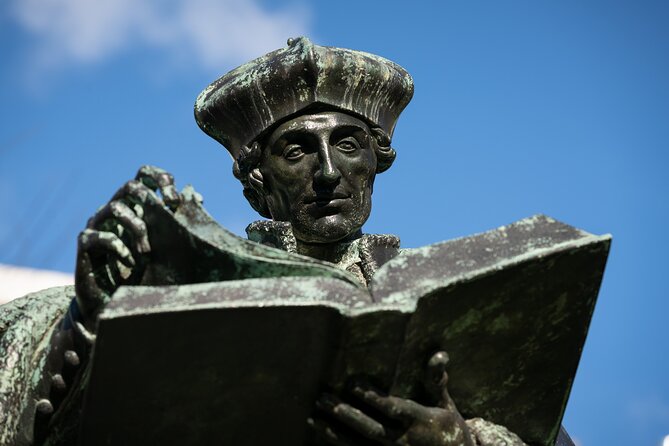
Then you meet the Erasmus Monument, honoring Desiderius Erasmus of Rotterdam, a major 16th-century philosopher, theologian, scholar, and priest. This stop is quick, but it gives context. Rotterdam names public buildings and institutions after Erasmus, and it signals that the city’s story is not only ports and steel.
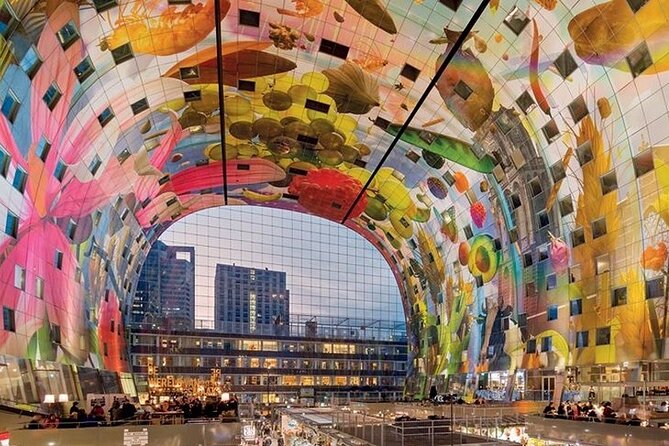
After that, you step into a different style of modern Rotterdam: Markthal. This horseshoe-shaped building combines a market with living and other facilities. It is nicknamed the Sistine Chapel of Rotterdam, which tells you how eye-catching the interior can be. If you like food markets, you will enjoy this one even as a short stop, because it is a “smell it and move through it” kind of place.
Kijk-Kubus Cube Houses: the one stop where the included ticket matters
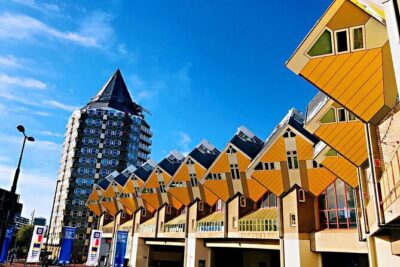
Kijk-Kubus (Cube Houses) is where the day becomes playful and tactile. These are the tree-looking structures with cube-shaped apartments stacked on columns. The design looks clever from the outside, but the real point is what it does to space: because of the shape, only about 3/4 of the inner space is usable for common living.
This is why the included admission is valuable. You get to understand the design choice, not just admire it. If you like architecture puzzles, you will leave with a stronger sense of how design and daily life can collide.
Oude Haven: the medieval port atmosphere that still feels lived-in
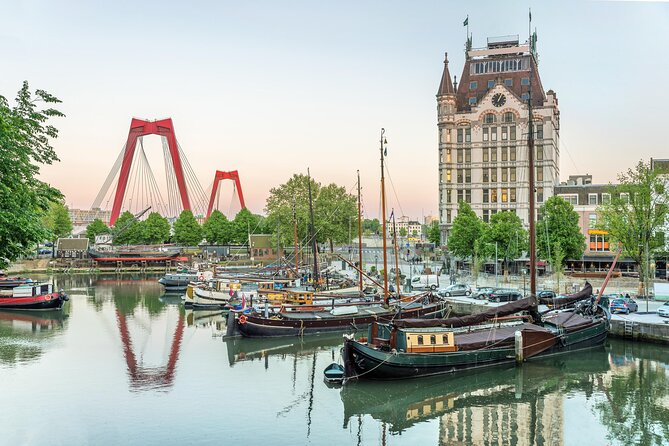
At Oude Haven, you are in the oldest-feeling part of Rotterdam. The area traces back to medieval port life, including the former river mouth connection of the Rotte flowing toward the New Meuse. Today, it is a gathering zone with coffee bars, restaurants, taverns, and nightlife.
This is a good contrast stop after the geometric modernism of Markthal and Cube Houses. It is also a place where you can take a breath, look at the waterfront energy, and spot the way Rotterdam’s past is used rather than sealed away.
The Red Bridge, De Hef, and why Rotterdam loves big engineering
Then you roll into the city’s engineering icons.
- Willemsbrug, often called the Red Bridge, dedicated to Willem III. It connects central and northern Rotterdam with southern districts.
- De Hef (meaning “The Lift”), a huge steel construction that once served as a rotating and lifting rail bridge across the New Meuse. It was in service before the rail tunnel went under the river.
These are not just bridges. They are symbols of how Rotterdam handled movement and trade. You will likely notice how much the city builds upward and outward, using structure as identity.
If your brain likes systems, these stops are where it clicks. Rotterdam’s skyline and waterfront are not random. They are functional decisions that became cultural landmarks.
War memorials and maritime layers along the New Meuse
As the walk continues, you get a quieter but important stop: De Boeg, a war memorial along the New Meuse commemorating 3,500 people who died aboard Dutch merchant ships in World War II.
Then you reach Leuvehaven, described as an open-air maritime museum. You are looking at steamships, docking cargo machines, ship engines, and related objects from the mid-19th century through the 1970s. Even if you do not go deeply into every object, you get a strong sense of how maritime work shaped the region’s economy and daily life.
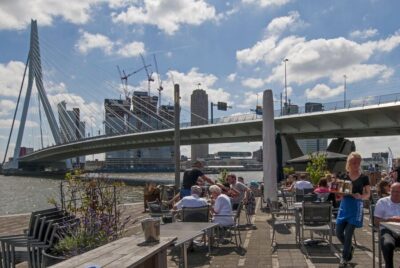
From there, you reach Erasmus Bridge. It is Rotterdam’s best-known symbol, sometimes called the Swan or the Harp. The bridge crosses the New Meuse and is listed at 139 m high, with a giant opening span of 80 m. It is the kind of landmark you can photograph from multiple angles, and it helps you understand why Rotterdam is so associated with water crossings.
Delft arrival: an energy-efficient station and a city that moves differently
Your Delft segment begins at Station Delft. This is an energy sustainable underground station, with new city hall above it. It also includes retrospective Delftware blue ceramics art and history, which is a clever way to transition you from Rotterdam’s steel-and-water feel into Delft’s craft-and-classic vibe.
If you have the energy, you might enjoy using this stop to set your expectations for the day. Delft is not trying to out-design Rotterdam. It is trying to preserve a cultural core.
Delft’s historic institutions: Meisjeshuis, NKI, and water governance
A series of stops follows that all share a theme: Delft’s institutions and the people they served.
- Sociëteit het Meisjeshuis: a girls orphanage from 1578, operating until the 1950s.
- The Netherlands Cancer Institute (NKI): marked with a monument tied to a Delft citizen connected with microscope development, alongside mention of Johannes Vermeer.
- Gemeenlandshuis van Delfland: a building from the early 16th century, headquarters of a local water management organization from 1645.
These are not always the “top ten” stops for casual sightseeing. But they are powerful if you like places that explain how a society functioned. Delft, like Rotterdam, is shaped by water. Here, you see it through governance and civic buildings rather than just docks and bridges.
Archives and Prinsenhof area: where old lessons and revolution intersect
Then you reach Stadsarchief Delft, formerly a Latin-language school and military barracks, now the city archive. Next is Museum Prinsenhof Delft. The tour notes the area includes the Prinsenhof residence, a headquarters, and the place of death of Willem The Orange’s father-in-context story, centered around Geertruyie van Oosten’s monument.
The Prinsenhof museum entry is listed as not included, so treat this stop as a look-at-the-place moment unless you choose to pay. Either way, it is a meaningful stop because it ties Delft’s cultural identity to national history.
Begijnhof area and the quiet structure of Delft’s spiritual life
At Bagijnhofpoort, you are in a semi-closed memorial and port area dedicated to the Beguines, a religious order similar to nuns. It is a calm kind of stop after the more dramatic waterfront engineering you saw in Rotterdam.
This is where you will appreciate the private format again. If your group wants quiet photo time, you can slow down here without feeling rushed.
Old Church and New Church: two towers, different kinds of weight
Delft’s churches come in two layers.
First, Old Church is described as the Dutch version of the leaning Pisa Tower, with an 1246 origin and a tower that leans about two meters from vertical, reaching 75 m. The Old Church entrance fee is listed as €8.00 per person (not included).
Then you reach New Church, noted at 108 m and described as the funeral place of Willem The Orange and members of the Dutch royal family. The entrance fee for New Church is listed as €15.00 per person (not included).
If you care about architecture and symbols, pick your moments. These churches can be a lot of standing and looking, and you will want to decide how much interior time you truly want to buy.
City hall, Vermeer Centrum, and the art of making meaning quick
You also pass Stadhuis Delft, the former city hall from 1620, one of the two main buildings on the main Delft market. Then there is Vermeer Centrum Delft, an information point about Johannes Vermeer’s work, painting style, and paint meaning and personal life. Its entrance fee is listed as €12.00 per person (not included).
You can treat Vermeer Centrum as an optional “fast context” stop. If you are a Vermeer fan, it helps you interpret what you will later see and read. If you are not, you can still enjoy the look at the building and keep the day moving.
Hugo de Groot Monument and Maria van Jessekerk: smaller stops, clear stories
Hugo de Groot Monument is a brief stop honoring a Dutch philosopher, jurist, humanist, writer, diplomat, and a founder of international law. It is listed as free, and it is one of the easier stops to appreciate because the name carries weight even at a glance.
Then you reach Maria van Jessekerk, a 19th-century Catholic church. This is listed as free admission. If your group likes churches but wants less ticket time, these free stops are a good way to keep momentum.
Royal Delft: the last stop that turns blue into a souvenir decision
The day finishes with Royal Delft – Koninklijke Porceleyne Fles, famous for majolica pottery and known for its thousands shades of blue. The tour lists admission as not included. This is the moment where you decide how you want to end: with a deeper look at workshop and exhibition, or with a quicker browse and a purchase.
I like this stop as a finale because it gives the day a practical ending. After architecture, bridges, ships, and towers, ceramics feels like a natural “take home” format.
Pace, comfort, and ticket budgeting tips that make the day smoother
A full 7.5-hour private day across Rotterdam and Delft is worth preparing for.
- Wear shoes you trust. Even with a guide and included travel time, you will still be on your feet for hours, with outdoor stops around water.
- Expect wind near the Nieuwe Maas. Rotterdam’s waterfront can feel colder than the city center.
- Bring your entry-fee math. You have separate listed fees for Nieuwe Kerk (€15), Museum Prinsenhof Delft (€14), Old Church (€8), and Vermeer Centrum Delft (€12). If you plan to go inside all of these, the cost rises fast.
- Use the guide’s flexibility. Alex is described as adjusting the tour based on interests and mobility limitations. If there is a stop you do not care about, swap it. If you need fewer stairs, ask early.
Also, note the tour is customized and capped at 4 travelers, which is the sweet spot for actually talking to your guide and not getting swept along.
Should you book this private Rotterdam & Delft walking tour?
Book it if you want a private, logic-based day connecting Rotterdam’s modern identity with Delft’s craft and institutions. The biggest reasons: the small group size, the included Cube Houses ticket, and the way guide Alex is known for real-world help and adapting the day for different needs.
Skip or reconsider if you are trying to keep costs very low, since private pricing is high and several key interiors require separate paid entries. Also reconsider if you hate a tight sightseeing rhythm. This is a full day, with many short stops designed to give you context quickly.
If you are the type of traveler who likes to understand what you see, not just pose for photos, this is a strong fit. You will walk away with a clearer picture of how Dutch cities use water, rebuild after damage, and turn trade and craft into everyday culture.
FAQ
How long is the Rotterdam and Delft private walking tour?
It runs for about 7 hours 30 minutes, with travel time included in the total duration.
How many people are in a group?
This experience has a maximum of 4 travelers, making it a small private group.
Is pickup available, and where does the tour start?
Pickup is offered in any hotel in Rotterdam or Delft. The meeting point is the Port of Rotterdam, Wilhelminakade 909, 3072 AP Rotterdam, and the tour ends back at the meeting point.
What’s included in the tour price?
Coffee and/or tea are included (within or after the tour), and entrance fees to the Cube Houses (Kijk-Kubus) are included.
Are there extra entrance fees I should budget for?
Yes. Entrance fees listed as not included are: Nieuwe Kerk (€15.00 per person), Museum Prinsenhof Delft (€14.00 per person), Old Church (€8.00 per person), and Vermeer Centrum Delft (€12.00 per person). Public transportation is listed as €10.00 per person.
Is the tour offered in English?
Yes, it is offered in English, and mobile tickets are provided.
Latest Rotterdam reviews
- Private Rotterdam Walking tour with expert local guide★ 5.0 · 3 reviews
- Rotterdam: Capture the most Photogenic Spots with a Local★ 5.0 · 3 reviews
- Keukenhof – spring garden from Rotterdam, Delf & The Hague★ 4.5 · 3 reviews
- Private tour from Rotterdam to Windmills of Kinderdijk & Gouda Cheese Experience★ 5.0 · 3 reviews
- Schiller Water Bike Rental in Maritime District Rotterdam★ 3.7 · 3 reviews
- Discover Rotterdam’s most Photogenic Spots with a Local★ 5.0 · 3 reviews
- Rotterdam: 2.5-Hour Leckers Boat Cruise and Buffet★ 3.2 · 3 reviews
- Private Transfer from Rotterdam Port to Amsterdam Airport (AMS)★ 5.0 · 3 reviews
Delft, compared.

Rotterdam, Delft and The Hague Day Trip from Amsterdam
Read our review →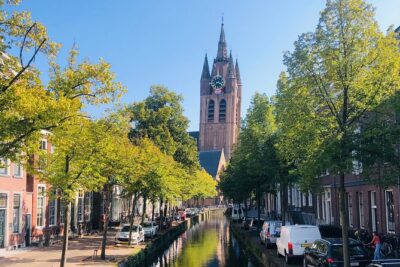
Rotterdam, Delft and The Hague Small Group Tour from Amsterdam
Read our review →
The Hague, Delft and Rotterdam Small-Group Tour (Max. 8 People)
Read our review →
Rotterdam, Delft, The Hague Day Tour Incl. Madurodam/Royal Delft
Read our review →Browse the lists this tour appears in