
Reviewed · CITY EXPLORATION GAMES
e-Scavenger hunt Schiedam: Explore the city at your own pace
Schiedam is one of those Dutch cities where windmills and jenever history are not museum-only, they show up right in the streets. This e-Scavenger hunt turns an ordinary walk into a little story game, with prompts that guide you between major landmarks at your own pace. I really like the phone-based format because it keeps you moving without forcing a rigid tour rhythm, and I like the way the questions connect the spots into one coherent theme instead of treating each place like a random stop.
The only real catch is the experience depends on your phone setup. If you hit login or starting glitches, the hunt can feel frustrating at first, and some prompts may take a second read to understand what the question wants. Plan for a smooth start, keep your phone charged, and you’ll enjoy the walk far more.
Key points to know before you play
- Self-paced city game for up to 6 people, priced per group, so it can be good value if you travel with friends or family
- Major Schiedam landmarks on the route, from windmills to churches to arts spaces
- English mobile ticket, so you can play without needing Dutch
- Smartphone and data are required, since they are not included
- A real contrast of stop types, distilling and churches in the same 2 to 3 hour loop
Why Schiedam makes an excellent phone scavenger hunt

Schiedam is built for wandering. The center feels compact, and the city’s identity is unusually specific: tall windmills and jenever distilling are not just trivia, they are part of the built environment. That matters, because a scavenger hunt works best when the landmarks are visible and rewarding even if you pause, backtrack, or slow down.
This hunt is also designed for real-world pacing. You are not lining up at attractions, you are reading clues and answering questions as you move. The route wraps around the kind of places you would otherwise skim past, like the story behind a stone scaffolding windmill built in 1794, or why the National Jenever Museum is in a former malt wine distillery (De Locomotief). You get the feeling that the game is teaching you how to look at the city.
One more practical reason it fits Schiedam well: the whole activity is set up for groups up to 6. That means you can talk through clues together, compare what you see, and still keep the pace comfortable. For a small group, it can feel like a guided stroll without the pressure of a tour guide timing your every step.
More self-guided city games in South Holland:
- e-Scavenger hunt Maastricht: Explore the city at your own pace
★ 4.5 · 110 reviews - e-Scavenger hunt Middelburg: Explore the city at your own pace
★ 4.5 · 55 reviews - Rotterdam Highlights & Spies: Interactive City Game
★ 4.0 · 51 reviews
The route in plain English: what you will see and why it matters
Your hunt starts and ends at Buitenhavenweg 7, 3113 BD Schiedam. Plan on roughly 2 to 3 hours walking time, depending on how often you stop to read, answer, and check where you are. The game is in English, and you get a mobile ticket on your phone.
Here is how the theme unfolds as you move from clue to clue.
Tall windmills, fewer than you might expect
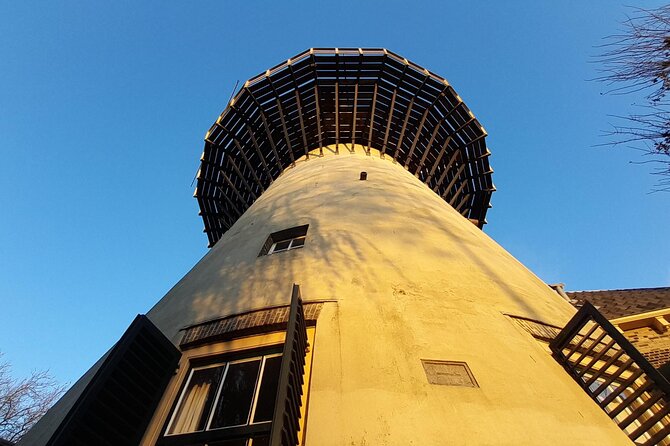
Schiedam is famous for classic windmills, and the city’s story has a built-in contrast. You are working with the fact that there were once twenty windmills, and now only six remain. Those windmills are not just scenery, they are key evidence of how Schiedam used industrial-scale distilling and storage.
As you play, look for the “classic” proportions: tall, purposeful silhouettes meant to catch wind and serve industrial work. The hunt’s windmill-related questions push you to notice details you might otherwise miss, like how the architecture signals the distilling era.
One stop in particular points you to a windmill built in 1794 on the Westvest, ordered by gin-burners as a stone scaffolding mill. The point is not the exact name alone, it is the context: the built structure tells you who paid for it and why.
Practical note: you are outdoors for these parts. Bring layers if the weather turns, and treat the first windmill area as your warm-up walk while you confirm your game is running smoothly.
Jenever Museum, De Locomotief, and why the location is the story
Next comes one of Schiedam’s best-known themes: jenever. The National Jenever Museum Schiedam is located since 1996 in a former malt wine distillery and distillery De Locomotief at Lange Haven 74.
That matters because distilling history is one of those topics where the building type is part of the proof. Being housed in an old distillery turns what could be generic alcohol history into something you can connect to real industrial space. The game uses this stop to make the theme feel less abstract.
If you do choose to step inside, you’ll likely get a deeper payoff. If you do not, you still get value by reading the clue context before you move on, so you understand what you are looking at on the outside.
A few other ways to fill a day in South Holland
- Amsterdam: 75 Minute City Canal Cruise with Audio Guide
★ 4.4 · 19,938 reviews - Amsterdam: City Centre Canal Cruise including Audioguide
★ 4.3 · 16,901 reviews - Amsterdam: Smoke and Lounge City Boat Cruise
★ 4.7 · 8,572 reviews - Amsterdam: City Canal Cruise and Heineken Experience Ticket
★ 4.5 · 5,367 reviews
Stedelijk Museum Schiedam, then and now
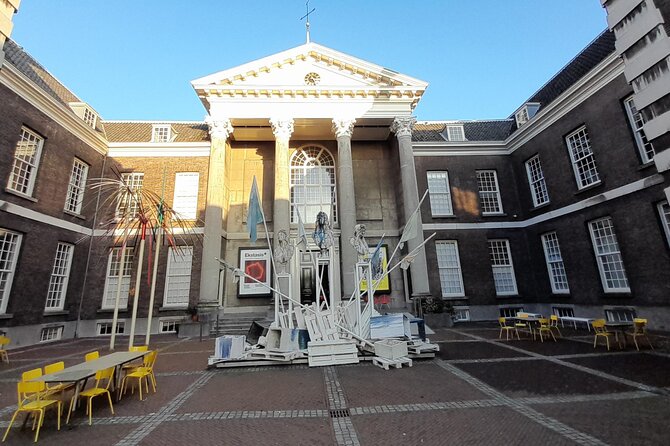
The Stedelijk Museum Schiedam is the place in the route tied to Dutch visual art of today, plus the stories of Schiedam then and now. This is a good “palette cleanser” stop, because it balances the industrial theme with culture.
You might treat this stop as two things at once. First, it gives your scavenger hunt a broader frame beyond windmills and spirits. Second, it reminds you that Schiedam is not only an industrial past, it has current creative life too.
In real terms, this is where you can slow down. If your group likes art and stories, this can be the stop where you spend a few extra minutes with the clues.
A library-and-courtyard style pause with city views
One of the most pleasant parts of this hunt is not a single famous monument, it is a study-and-reading environment: a large collection of books, a beautiful courtyard with a reading table, and many study areas with a magnificent view over the historic center.
Even if you do not know exactly which building this refers to when you arrive, the game nudges you toward noticing how the space works: where people read, how the courtyard frames a break from street life, and how the view reconnects you to the historic core.
This stop is a great reason to play with a small group. You can take turns answering questions, then swap your impressions of what you see around the courtyard.
Another windmill stop with gin-burner fingerprints
The hunt returns you to windmill context with another clue tied to that 1794 story and the Westvest location. You are effectively getting a second look at the idea of windmills as infrastructure.
That repetition is useful. After the first windmill area, you start to recognize the patterns. By the time you reach the 1794 clue area, you are more ready to connect shape to function.
Churches that anchor Schiedam’s timeline
Schiedam’s religious architecture is a major theme in the hunt, and it is not just about aesthetics.
First up is St. John’s Church, also known as the Grote Kerk. The clue story ties it to a church on the site from the 13th century, and it gives you a sense of how long this place has mattered.
Later, the route includes the Basilica of St. Liduina and Our Lady of the Rosary, a neo-Gothic Roman Catholic church built between 1878 and 1881.
What I like about this church pairing in a scavenger hunt is the timeline contrast. You get one older foundation narrative and one more modern construction narrative. Even if you only look from outside, the game helps you read buildings as history, not just walls.
Theater aan de Schie for a modern community rhythm
Next, you get a cultural stop that shifts the mood: Theater aan de Schie. The clue context emphasizes that it offers a varied program in all genres and for all ages every season.
In a walking game, this is smart programming. It reminds you that Schiedam is living now, not only preserved. It also gives you something human-sized to think about. The building suggests performances and community gatherings, not just industry.
Huis te Riviere ruin and Aleida of Avesnes, nearly hidden
Not every clue is obvious. Near the municipal area, the hunt points you to the ruin of the former Huis te Riviere, tied to the castle of Aleida of Avesnes.
I love this kind of stop because it trains your eyes. Ruins can feel random if you do not have context. The clue gives you a specific person and place to attach to what you are seeing. You end up with a small payoff moment, the kind you remember later.
Distillers Academy in the Dutch Distillers District
Finally, the hunt brings you to the Distillers Academy in the Dutch Distillers District Schiedam. The clue story frames it as a place where you can learn everything about refined distillation process and the history of Schiedam’s distillates.
Even if you only use the game to read and answer, this ending makes sense. You started with windmills, moved into distilling buildings, and then you finish with education. It leaves you with the feeling that distilling is both craft and industry.
Price and value: what $36.69 per group buys you
At $36.69 per group (up to 6), this hunt can be a very workable deal. If you spread the cost across 4 to 6 people, you are typically looking at a low per-person price for a structured walk that takes you through a lot of major city stops.
This is where you should think like a value shopper. You are paying for a ready-made route, the Qula game experience on your phone, and a set of prompts that turn the city into an interactive activity. You are not paying for museum tickets or guided commentary from a live person, so the value is in how well the game connects the dots as you walk.
If your group likes self-directed activities, this price makes sense. If your group hates phones, slow reading, or app-based games, you might find it less satisfying than a traditional guided tour.
Group size and pacing: why small groups work best here

The activity is private for your group only, with a cap of 6 people. That cap matters. It keeps the experience tight enough that you are not bumping into strangers at every stop.
It also affects how the game feels socially. In a smaller group, you can take turns reading clues, comparing answers, and deciding when to stop for photos. In a bigger crowd, you would likely get friction. Here, the design fits the group.
The duration, 2 to 3 hours, is another reason it works. It is long enough for an experience with multiple landmark stops, but short enough that you can still plan a relaxed meal afterward.
How to keep your start smooth on the day you play
One of the most practical issues that can affect your enjoyment is getting the game running fast. There have been cases where people had trouble with login and starting, including wrong codes, which caused delays until help resolved it by phone.
So do this:
- Arrive with your phone charged and ready.
- Do not wait until you are standing at the start to figure out the app basics.
- If you have multiple people using multiple phones, make sure each person can log in correctly before you begin.
Also, use navigation carefully. A local tip from a player says that if you ask Google for Buitenhavenweg 7, it may route you to the end of the street instead of the start, which can cost you a half-hour walk. Double-check you are at the right point near the start area.
For parking, one practical note is that there can be a public parking lot on Buitenhavenweg just behind the Koemarkt, around €8 per day, and only a short walk from the start. That is useful if you are driving in.
Stop-by-stop practical notes, so you know what to expect
You will cover a mix of settings, so it helps to know the vibe of each one.
- Outdoor windmill areas: plan for weather and bring shoes you do not mind using on sidewalk turns and short stretches.
- Museum and cultural buildings: treat them as clue stops. The game gives you context, and if you go inside, you get extra payoff, but even outside you get story value.
- Courtyard and reading spaces: this is where your group can slow down and actually enjoy the architecture and view while you answer.
- Churches and basilica: expect strong landmark presence. Even when interior access is not part of your plan, the buildings make the questions easier to answer because they are visually distinctive.
- Hidden ruin: move slowly here, because you want to spot the remains the clue points to.
If your group is flexible, you can also adjust your route a bit if something feels more logical. One player noted they adjusted the order for common-sense logic, and that is exactly how this type of scavenger hunt should feel, a guided feeling without strict rails.
Best ways to use this hunt for a bigger Schiedam day
This hunt is a strong “anchor” activity. It can be the middle piece of a day that also includes food and optional indoor time.
If you are staying in the area or planning a longer day, add a meal after you finish back at the starting point. One practical post-hunt suggestion is to eat pancakes at Restaurant Pannekoe, which a player paired with the town hall area and found delicious.
You can also plan around current city changes. A player noted that Schiedam is being renovated for its 750th anniversary in 2025. If you happen to visit around that period, you may see work in progress, which can change shortcuts and street details.
Who should book this e-Scavenger hunt
This is a great fit if:
- you want a low-pressure activity that still has structure
- your group likes facts and questions tied to real places
- you prefer walking on your own schedule, not chasing a strict itinerary
- you are traveling with friends or family who enjoy puzzles or quick trivia
It might not be for you if:
- you dislike smartphone games or struggle with app logins
- your group wants a lot of guided explanation from a person
- you are looking for a classic museum day with guaranteed entry times
Should you book this Schiedam hunt?
Yes, you should book it if you want a practical way to connect Schiedam’s signature themes, windmills and jenever, with churches, art spaces, and a few surprises like the Huis te Riviere ruin. The low per-person cost for groups up to 6 is a real plus, especially when you play as a team.
Just come ready for the basics: bring your phone and data, confirm your start works before you set off, and watch your navigation to avoid being led to the wrong end of Buitenhavenweg. Do that, and you will end with the kind of Schiedam memory that feels earned, not just seen.
FAQ
How long does the e-Scavenger hunt take?
It takes about 2 to 3 hours.
What does it cost?
The price is $36.69 per group, for up to 6 people.
Is this activity private?
Yes. It is a private tour or activity, and only your group participates.
What language is it in?
The activity is offered in English.
Do I need a smartphone?
Yes. Use of a smartphone and data is not included, so you will need your own device and mobile data.
Where does the hunt start and end?
It starts at Buitenhavenweg 7, 3113 BD Schiedam, Netherlands, and ends back at the same meeting point.
What are the operating hours?
It is available Monday through Sunday from 12:00 AM to 11:59 PM, with the activity running from 04/26/2022 to 12/08/2026.
Latest South Holland reviews
- Enjoy the Tulips in a Landrover with a local guide★ 5.0 · 4 reviews
- Interactive Sailing Day near Amsterdam★ 5.0 · 6 reviews
- Drive it yourself electric Dune & Summer Flower GPS audio tour★ 5.0 · 24 reviews
- Drive it yourself electric Dutch Countryside GPS audio tour★ 5.0 · 33 reviews
- Taking Pictures in the Tulip Field at De Tulperij★ 4.5 · 35 reviews
- Drive it yourself electric History and Castle GPS audio tour★ 4.5 · 35 reviews
- Enjoy the tulip fields by bicycle with a local guide! Tulip bike tour!★ 4.5 · 51 reviews
- Drive it yourself electric Dune and Beach GPS audio tour★ 5.0 · 129 reviews
City Exploration Games, compared.

e-Scavenger hunt Maastricht: Explore the city at your own pace
Read our review →
e-Scavenger hunt Middelburg: Explore the city at your own pace
Read our review →
Discover Utrecht with a self-guided Outside Escape city game tour
Read our review →
Rotterdam Highlights & Spies: Interactive City Game
Read our review →
e-Scavenger hunt Den Bosch: Explore the city at your own pace
Read our review →
Discover Delft with a self-guided Outside Escape city game tour!
Read our review →
e-Scavenger hunt Utrecht: Explore the city at your own pace
Read our review →
e-Scavenger hunt Groningen: Explore the city at your own pace
Read our review →Browse the lists this tour appears in