
Reviewed · SECOND WORLD WAR HISTORY
Rotterdam Walk: Hilights, Gems, Architecture & WWII | 2 or 3hrs
Rotterdam’s past is written in steel and brick, and this short walking tour connects WWII damage to the city’s modern comeback. What makes it interesting is how the route moves from museum-culture to harbor views, then lands on architecture you can’t miss, all with clear storytelling.
I love the way the guide uses photo-led comparisons to explain how Rotterdam changed after the war, without turning it into a lecture. I also love the lineup of Erasmusbrug, Witte Huis, and the Cube Houses that you can spot on your own later, so the tour helps you navigate the city after.
One consideration, though, is that it’s a walking route that depends on good weather. If rain is heavy, you may still go forward but you will be outside for plenty of the time.
Key highlights you should know before you go

- Small group (max 15), which makes it easier to ask questions and keep up the pace
- WWII stories at major landmarks, especially Erasmusbrug and Square 1940
- Architecture in a logical order, from Witte Huis to the Cube Houses on Overblaak
- Harbor-quarter views from Nieuwe Werk, with big city sights across the Maas
- Finish inside the Markthal, so you can immediately eat and keep exploring on your own
A WWII to modern design walk that stays practical
Rotterdam can feel confusing at first, especially if you’re used to older European city centers. This walk helps you get your bearings fast, because it doesn’t just point at famous buildings, it explains why they ended up where they are and what replaced what.
You’ll also get a local perspective that leans personal. In the past, guides on this route have included Rotterdam locals like Yoreh, who brings humor and uses visual material to show wartime destruction and postwar redevelopment.
The format is built for real sightseeing: short stops, quick context, and plenty of “look at that” moments. That is ideal if you want to understand Rotterdam in a single afternoon, not over multiple museum visits.
More Walking Tours in Rotterdam
- Rotterdam: Architectural Highlights Guided Walking Tour
★ 4.8 · 215 reviews - Rotterdam: Highlights, Gems, Architecture & History Walk
★ 5.0 · 191 reviews - Rotterdam 2-Hour Walking Tour | Discover The City With A Local
★ 4.5 · 111 reviews
Museumpark start at Depot Boijmans van Beuningen and the Land of Hoboken
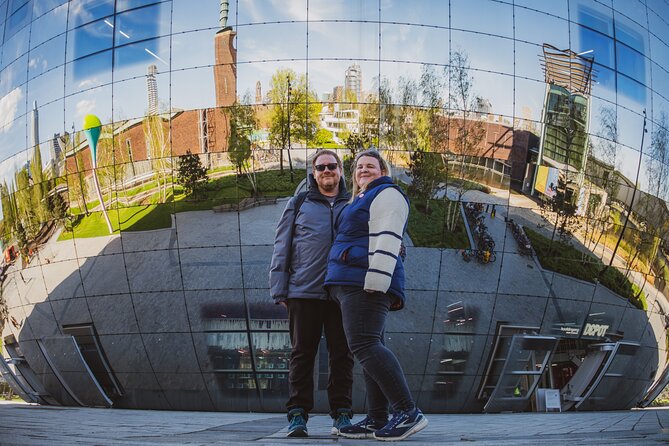
The tour begins at Depot Boijmans van Beuningen, the mirrored art depot near the Museumpark area. The building itself gives you an instant Rotterdam vibe: modern, sharp-lined, and designed for a city that rebuilt itself rather than preserving everything from the past.
This stop is also your orientation. You’ll learn how the Museum District fits into Rotterdam’s story and you’ll hear about the Land of Hoboken, a local reference point the guide uses to frame what you’ll see later along the walk.
Since the tour lists free admission for this stop, you’re not paying extra just to stand around and take it in. The tradeoff is time, it’s only a short window, so come ready to absorb rather than plan a deep art visit.
Nieuwe Werk in the Shipping Quarter, wide views over the Maas
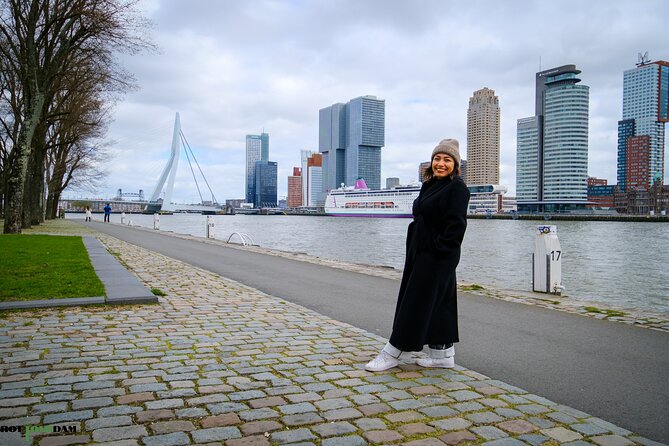
Next you move to Nieuwe Werk, in the Scheepvaartkwartier, the shipping quarter on the outer edge of the center. This is where Rotterdam’s scale becomes obvious. From the river side, the city opens up into big distances, water views, and shipyard-adjacent landmarks.
You’ll see key sights from along the Maas, including Hotel New York, the Steam Ship Rotterdam, and a view of the Erasmusbrug. Even if you already plan to photograph the bridge, it’s useful to see it from this angle first, because it gives you a “where am I in the city” reference.
This stop is usually quick, but it’s a smart reset after the museum-area start. You can use it to spot how the harbor quarter connects to the rest of Rotterdam’s core.
Erasmusbrug and Square 1940: WWII stories in plain sight
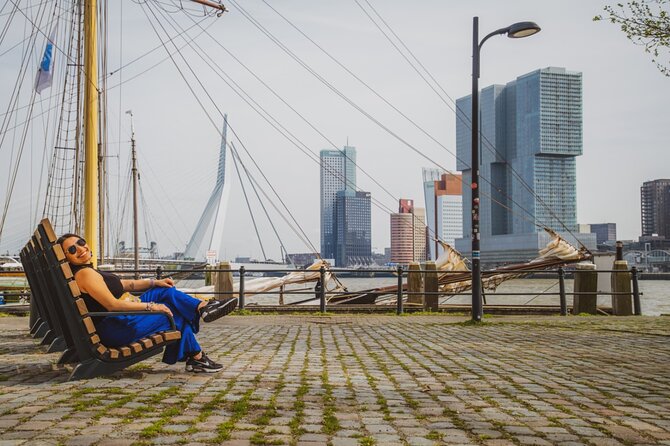
When you reach Erasmusbrug, the wide white bridge becomes more than a photo. The guide ties it directly to WWII events, including the invasion and the bombardment of Rotterdam and what it meant for daily life.
This is one of the most praised parts of the tour, because it blends landmark recognition with real context. Guides have a habit of using photos to show what used to be there and what got rebuilt, so your brain starts linking the present scene to the past damage pattern.
Then the walk continues to Square 1940, where you’ll stop at The Destroyed City statue by Ossip Zadkine. This is a powerful way to understand how Rotterdam processed loss while still moving forward. It’s not just a war marker, it’s a reminder that the city’s rebuilding shaped its identity.
A practical note: these areas include outdoor viewing space. Wear shoes you trust, because you’ll want to linger for a better angle without feeling rushed.
More modern architecture walks in Rotterdam:
- Rotterdam: De Rotterdam, Cube Houses, Watertaxi and Markthal
★ 4.7 · 112 reviews - Rotterdam Architecture Highlights Walking Tour
★ 5.0 · 66 reviews - Rotterdam: Markthal Tour, Meet & Taste, and Het Witte Huis
★ 4.3 · 36 reviews - Rotterdam Tour with Cube House Admission
★ 4.4 · 27 reviews
Maritiem Museum Rotterdam: the boats that age right in public
At Maritiem Museum Rotterdam, you’ll step into an open-air feeling where old ships and maritime history are visible without needing a ticketed indoor museum circuit. The walk passes through a collection of boats that can be over 100 years old, which makes the whole place feel like a timeline you can walk through.
This stop works especially well after the WWII stops. It shows how Rotterdam’s connection to water was not a minor detail, it was the backbone. When you see aging vessels up close, you get a better sense of why postwar rebuilding had to include shipping and port life.
The stop is short, so don’t expect a full museum experience here. Instead, treat it like a “meet the atmosphere” moment, then save deeper maritime time for another visit if you’re interested.
Witte Huis and Oude Haven: rebuilt modernism meets the oldest harbor feel
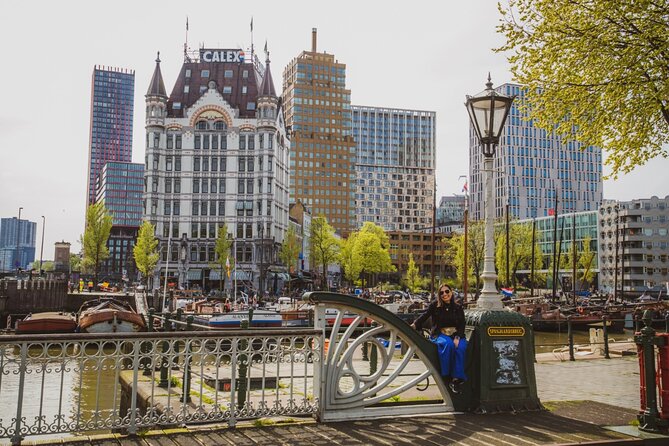
Next comes Witte Huis, often described as a major office-tower landmark that used to be the tallest office tower in Europe. In a city famous for construction and experimentation, this building helps explain how Rotterdam embraced modern design with real ambition.
Then you head to Oude Haven, one of the oldest harbors in the Netherlands, and also one of those places that makes you slow down. It feels cozy compared with the larger shipping views earlier in the walk, and you get a clear payoff in what you’ve been building toward.
From Oude Haven, you’ll look toward the Cube Houses, setting you up for the next stop. It’s useful to see them from a distance because the cube concept makes more sense when you’ve already seen the city logic around it.
If you like architecture, this section is a good reminder that Rotterdam’s modern look isn’t random. It’s connected, from tower to harbor to experimental housing.
Cube Houses on Overblaak: walk the concrete forest and enter the idea
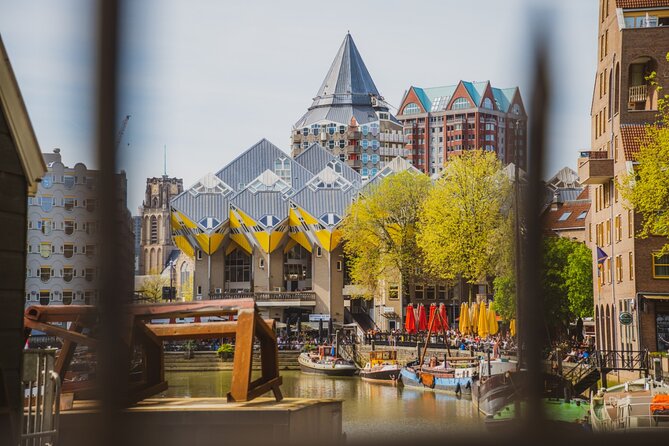
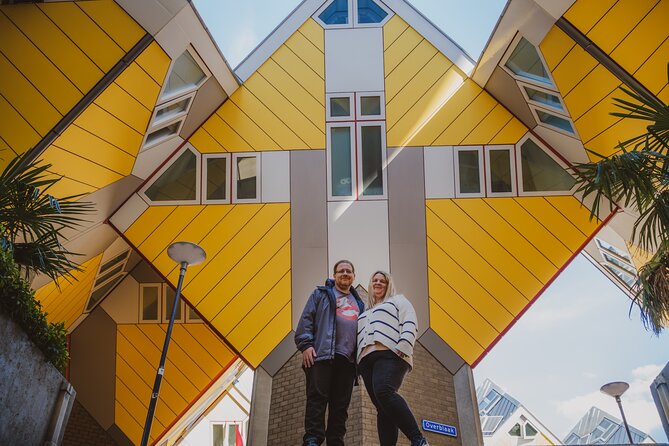
The tour reaches Kubuswoningen on Overblaak, the famous cube houses that turn everyday movement into a design statement. You’ll learn why this concept exists and how the architecture works, and you’ll walk through what’s described as a concrete forest on your way toward the market square area.
This stop is where first-time visitors usually get that “oh, that’s why this city is different” feeling. You’re not just looking at a building, you’re seeing a system, angled shapes, and urban planning that treats housing like sculpture.
The tour also lines you up for more exploration right after the walk. The guide explains what to check, and you can enter a demo cube house on your own once you reach the finish area.
If you’re the kind of person who likes to understand how a place works, not just what it looks like, this is the part you’ll remember most.
Markthal finish inside the indoor market hall
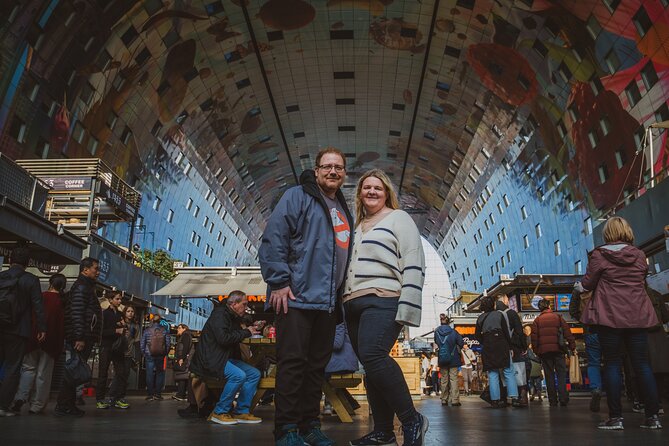
The walk ends in Markthal, a modern indoor market with food and color, and it’s often compared to a modern Sistine Chapel because of the ceiling-style wow factor. Finishing here is smart, because it turns sightseeing into an immediate break.
You’ll get a full explanation of both the cube houses and Markthal, then you can keep exploring at your own pace. Since the end is inside the market hall, it’s also a practical option if weather turns.
Bring a small hunger with you. Even if you don’t plan a full meal, Markthal is the kind of place where you’ll want to snack and keep walking afterward.
Pace, weather, and value for about 49.60
This is listed as a 2 to 3 hour walking experience, with a maximum group size of 15 and a mobile ticket. It’s offered in English, and it’s also set up for people who want to ask questions without getting swallowed by a large crowd.
The price is $49.60 per person, which is reasonable for what you get here: multiple big landmarks plus built-in context about WWII, postwar rebuilding, and why modern Rotterdam looks the way it does. The stops list free admission, so the cost is mainly for interpretation and guidance rather than entrance fees.
Two practical tips matter most. First, go dressed for walking, because the route includes river-area outdoor sections. Second, do this earlier in your trip if you can, so the landmarks you learn become your map for the rest of your day.
The tour also depends on good weather. If the operator cancels for poor conditions, you can expect a replacement date or a refund based on what they offer.
Should you book this Rotterdam walk?
I’d book it if you want a fast, structured intro to Rotterdam that connects the city’s rebuild story to real places you can return to later. It’s a strong choice for architecture fans, history-curious visitors, and anyone who wants WWII context that doesn’t feel stuck in a classroom.
Skip it only if you dislike walking, hate outdoor portions, or already have a deep Rotterdam guidebook plan that covers these landmarks in your preferred style. Otherwise, this is one of the better ways to understand Rotterdam without spending your whole day on transit between far-apart sights.
FAQ
How long is the Rotterdam walk?
It lasts about 2 to 3 hours.
What does it cost?
The price is $49.60 per person.
Is the tour in English?
Yes, it is offered in English.
Where do I meet, and where does the tour end?
You start at Vaimoo deelfietsstation MelkkoppadMuseumpark 20, 3015 CX Rotterdam, Netherlands, and you end inside Markthal at Verlengde Nieuwstraat, 3011 GX Rotterdam, Netherlands.
What is the group size limit?
The tour has a maximum of 15 travelers.
Are service animals allowed?
Yes, service animals are allowed.
Does the tour require good weather?
Yes, it requires good weather.
Can I cancel for a full refund?
Yes. You can cancel up to 24 hours in advance for a full refund.
Latest Rotterdam reviews
- Rotterdam Private Walking Tour with a Local★ 5.0 · 15 reviews
- Private Walking Food Tour of Rotterdam★ 4.5 · 15 reviews
- Rotterdam: Guided Food Tour★ 4.4 · 16 reviews
- Kinderdijk Area Cycling Tour★ 5.0 · 17 reviews
- Rotterdam: Architecture Highlights Tour including the Depot★ 4.6 · 17 reviews
- Skip the Line: SS Rotterdam Steam Ship Entrance Ticket★ 4.5 · 18 reviews
- Rotterdam: Summer Cocktail Cruise★ 4.7 · 18 reviews
- Rotterdam: Pub Cruise with Drinks and Bites★ 4.0 · 19 reviews