
Reviewed · SECOND WORLD WAR HISTORY
Amsterdam in World War Two Cycle Tour
WWII has a way of turning a city into a map of choices, danger, and courage. This Amsterdam bike tour is interesting because it takes you off the usual route and shows how ordinary streets were used for extraordinary oppression and resistance. I love the before-and-after WWII photos that match what you see today. I also like that it is a tight group, max six riders, so the guide can slow down and answer questions instead of herding people like luggage. The main drawback is also obvious: you need to be comfortable cycling in Amsterdam streets, since the tour is built for moving, not standing still.
It runs about 2 hours 30 minutes to 3 hours 10 minutes, in English, and uses a mobile ticket. Expect a respectful, facts-forward ride through the southwestern part of the city, with the guide, Rudy, sharing stories rooted in these neighborhoods. On some departures, Peter is also named as a guide, and both are praised for being well-prepared with maps, archives, and crisp navigation.
The good stuff you will notice on the ride
- Small group max six riders, which helps you hear the details and move at a human pace
- WWII photo comparisons that show the same streets under occupation
- Bike access to areas of Amsterdam South that are hard to reach on foot or by car
- Real names and real functions of Nazi offices, resistance actions, and roundups
- A safe, structured cycling flow, including a short coffee and restroom stop
Why a bike tour is the smart way to see occupied Amsterdam
Amsterdam’s WWII story is not locked behind museum walls. It is sitting in plain sight, in doorways, squares, and street corners where life kept going until it did not. Cycling is the difference maker. You cover more ground than walking, and you can reach the quieter corners of Amsterdam South without the stop-start frustration that comes with buses and crowds.
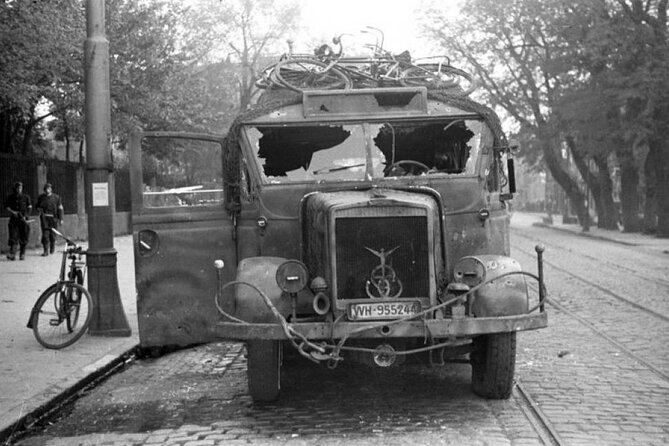
What makes this tour especially effective is that the guide does not just point at plaques. He brings you to the exact spots connected to major events, then gives you the visual punch of occupation-era photos lined up with what you see now. That combo turns abstract history into something you can track with your own eyes. One of the strongest moments is when the street scene looks normal today, while the photo from the 1940s shows how the same location was used for arrests, offices, or military functions.
Also, the route is built for staying steady. You are not jumping on and off transportation all day. You ride, you stop briefly, you ride again. That matters when the topic is heavy. Moving at a calm rhythm helps the information land without you feeling rushed.
More bike tours in Amsterdam:
- Big Bike tour Amsterdam – See all in 3 unforgettable hours
★ 4.7 · 4,929 reviews - Small Group Guided Bike Tour of Amsterdam’s Hidden Gems
★ 5.0 · 3,936 reviews - Amsterdam: Off the Beaten Path Bike Tour in French
★ 4.9 · 1,632 reviews
Before you pedal: timing, meeting point, and what to expect
The tour starts at 11:00 am. Meet at Tesselschadestraat 1, 1054 ET Amsterdam. It ends back at the meeting point, with the last stretch guided through Vondelpark toward Leidseplein where the ride began.
Duration is listed at 2 hours 30 minutes to 3 hours 10 minutes, so plan for a half-morning. The tour is offered in English and you will get a mobile ticket. The group is capped at six travelers, which is a big deal for a history tour, since you want time to ask follow-ups without the guide speaking over everyone.
About bikes: the tour is described as a bike ride experience, and advice shared is to bring your bike. If you are renting, do it early and test the brakes, because you will be cycling through real city streets, not a calm bike path.
One more practical point: this is WWII history. You will hear names of people who were arrested, deported, executed, and betrayed. It is handled in a factual, respectful way, but it is still emotionally intense. If you know that long-form tragedy is not your thing, you might prefer a lighter theme. If you are okay with serious history, this format is excellent.
Victorieplein (Daniël Willinkplein): the June 20, 1943 Judenaktion
The tour kicks off at Victorieplein, which was called Daniël Willinkplein during the war. On June 20, 1943, a major raid hit Amsterdam. This is one of the most important “start you in the deep end” locations because it sets the tone for what follows.
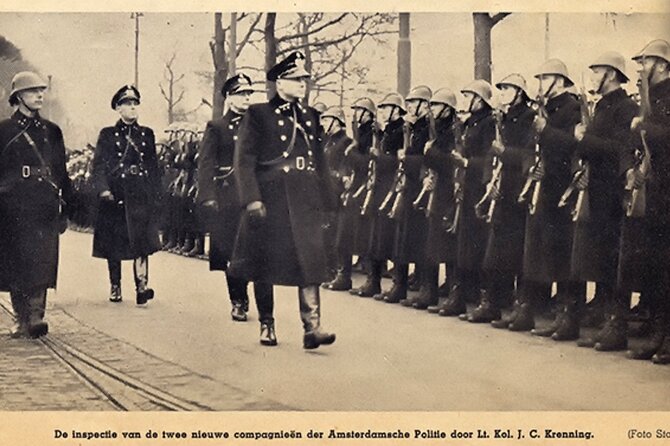
At the foot of the nearby skyscraper area, the Nazis carried out a so-called Judenaktion, arresting large groups of Jewish citizens during the raid. The tour also highlights something that can be easy to forget: this was not only German action. It involved Dutch police units (the PBA, Police Battalion Amsterdam) and police volunteers from the Dutch Nazi movement NSB. After arrest, people were transported, including to Olympiaplein, then ultimately toward the Westerbork concentration camp in the east of the Netherlands.
Why this stop matters for you: it explains how the machinery of persecution worked at street level, not just as a “far away” concept. You get the who, the where, and the process. And because you are standing in the same urban space used during the occupation, the details hit harder.
A small caution: this is not a quick photo-op. You should be ready to absorb it.
Merwedeplein and the Anne Frank connection that still feels personal
Next comes Merwedeplein 37-II on the third floor by American counting. This was the home of the Frank family. In the summer of 1942, Otto Frank brought his family and some acquaintances to Het Achterhuis, the Secret Annex on the Prinsengracht where his company was located.
There is also a statue commemorating Anne Frank at Merwedeplein, and the tour uses that to connect the famous story to a specific Amsterdam address you can actually find and picture. Around the corner is the Waalstraat bookstore, where Jimmink (still active) sold the first edition of Het Achterhuis in 1947, after Anne’s diary was published.
The really striking detail is that it was in this kind of bookshop setting that Otto Frank bought the diary for his daughter. That turns the story from a distant text into something tied to daily commerce and postwar publishing.
For you, this is the emotional center of the ride. Not because it is the most “famous” stop, but because the guide anchors it in exact places you can stand in, and then adds a human layer: how the diary moved from tragedy into the world.
A few other ways to fill a day in Amsterdam
- Amsterdam: Van Gogh Museum Ticket
★ 4.7 · 52,054 reviews - Amsterdam: Heineken Experience Ticket including 2 Drinks
★ 4.6 · 36,014 reviews - Amsterdam Classic Saloon Boat Cruise with Drinks and Cheese
★ 5.0 · 31,825 reviews - Amsterdam Luxury Canal Cruise + Unlimited Drinks & Bites option
★ 5.0 · 30,518 reviews
Waalstraat 48, now Café Blek: Tilex Bar and Lex van Weren’s trumpet
Across from Merwedeplein, at Waalstraat 48 (today Café Blek), you find the former Tilex Bar. The tour notes it was once associated with Tilly and Lex, van Weren.
Here the story turns on a chilling detail: Lex van Weren survived Auschwitz because he had to play his trumpet at executions. It is one of those facts that makes you stare at the street longer than you planned, because it is impossible to file away as “just history.” It is about talent, forced performance, survival, and the horror of what people were compelled to do.
Practical takeaway: you are not just learning facts. You are learning how to pay attention. The tour trains you to notice the human threads behind the places.
Cornelis Troostplein 23 and the occupation’s operational core
At Cornelis Troostplein 23, the building once held PBA barracks. Before WWII, the complex was called “peace parish,” a Catholic site that included two convents and a school. In spring 1942, the head of the Sicherheitsdienst (SD) / Gestapo, Rauter, inspected the PBA, and met with Reichsführer-SS Heinrich Himmler at Museumplein.
So you can see the pattern: religious and civic spaces were repurposed for control. It is not only about raids. It is also about logistics, offices, and systems running out of buildings you would never guess were used that way.
Museumplein stronghold: offices, Flak batteries, and the NSB HQ
This is a big stop and a big payoff. During the war, the Germans transformed Museumplein into a stronghold.
When you face the concert hall, the houses on your left were occupied by German offices. The tour calls out examples, including the former United States consulate building, which housed the Zentralstelle für Jüdische Auswanderung (Central Jewish emigration office, a euphemism for persecution and deportation). Next door, you would find the Ortskommandantur (Town Major) and the Feldgendarmerie (Military Police) building. Other buildings held Nazi party offices and other German services.
Then comes the square itself. On the square in front of these buildings was the IJsclubterrein (Amsterdam skating club). The Germans built their stronghold there with bunkers and anti-aircraft, Flak batteries. Next to the concert hall, you also get the NSB HQ Amsterdam reference.
After WWII, the bunkers were blown up, which is why the area looks like it does today. That is the point, and the guide makes it clear: normal streets can hide intense wartime infrastructure.
If you like military history mixed with everyday urban geography, this is where the tour clicks for you.
Roelof Hartplein: coffee, restrooms, and resistance photography
Mid-ride, you hit Roelof Hartplein, with a short stop for coffee and a restroom visit at Café Wildschut. The scheduled stop is 10 minutes and listed as free.
Then the tour walks you into a quieter kind of WWII evidence. On Roelof Hartstraat, the resistance used a photo shop next to the library building. They developed unique photos, including work connected to Charles Breijer, showing the first roundup of Jews in Amsterdam by the SD/Gestapo and German police.
There is also a small monument remembering Jews taken from this neighborhood. This is one of those stops where a little marker in a modern street still carries the weight of an entire community.
Beethovenstraat and Apollolaan: retaliation you can still trace
At the corner of Beethovenstraat and Apollolaan, the tour connects the street to a specific act of resistance and Nazi retaliation.
In late October 1944, about in front of house number 6 (the guide notes most house numbers are still the same as during WWII), Herbert Oelschlägel, an SS officer and SD/Gestapo agent, was executed by a Dutch resistance member. The retaliation was immediate and brutal by occupation standards: the SD/Gestapo burned down two houses and executed 29 resistance fighters.
The tour also notes that at the time, the street was called Euterpestraat, and it ties you to Gerrit van der Veen, described as the leader of an important Dutch resistance group.
Why it is useful for your understanding: it shows how resistance and repression were tangled together. You are not only seeing “one event.” You are seeing the cause and effect pattern.
Memlingstraat and Rubensstraat: SD HQ, stolen possessions, and a RAF target
Now you move to corners tied to some of the most important Nazi oppression organizations. At the corner of Memlingstraat and Rubensstraat, the tour identifies two offices.
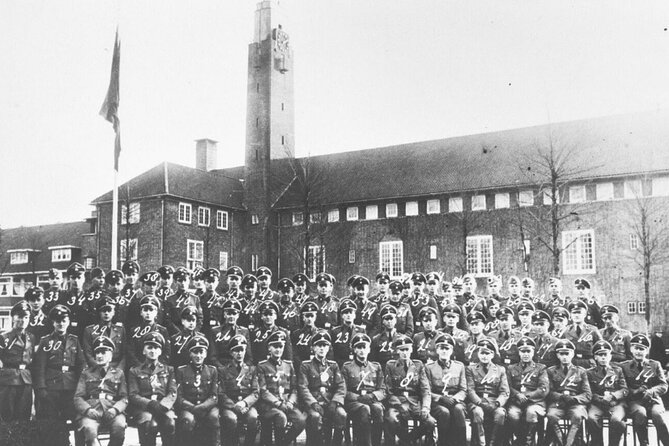
First was SD HQ Amsterdam, described as an SD Außenstelle under Willy Lages. Second was the Hausraterfassungsstelle, the place for stealing possessions of deported Jews, part of the Zentralstelle für Jüdische Auswanderung. The tour notes the leader was a Dutch collaborator named Henneicke.
Then the story becomes about resistance strategy. In November 1944, the resistance sent a secret radio message to the Royal Air Force, requesting an attack on these SD/Gestapo and Hausraterfassungsstelle headquarters. The main goal was destroying SD/Gestapo files.
The tour ties the action to Group Captain Denys Gillam, with the description of DSO, DFC, AFC, and as the leader of 149 (Typhoon) wing. That name matters, because it turns the “air war” into a concrete response to resistance intelligence.
The tour also points you to a resistance safehouse at Rubensstraat and Gerrit van der Veenstraat, referencing Stolperstein for the address. It notes that in June 1944, the address was betrayed to the SD/Gestapo by a female informant, listed as V-Frau.
This is heavy material, but it is valuable because it teaches you how history got made through information networks, betrayals, and targeted strikes.
Olympiaplein and Parnassusweg: registration with help from Westerbork
At Olympiaplein and Parnassusweg, the tour revisits a key part of the June 1943 raid. Jewish people arrested during that June 1943 raid at the sports complex were registered on this square by the SD/Gestapo, with help from Jewish camp police sent from Westerbork.
If you want to understand how deportation worked beyond the headlines, this stop is the “process” lesson. It shows the steps, the paperwork, the staging.
A good guide makes sure you do not rush through this. You stand still long enough to absorb that the same system that took people also needed people to process other people.
Valeriusplein, the Amsterdam Lyceum, and the Luftwaffe endgame
At Valeriusplein and the Amsterdam Lyceum, the tour explains that the school building was used as the headquarters of the Luftwaffe at the end of the occupation.
This is where a school becomes a command center. That kind of repurposing is one of the most disturbing “everyday” lessons of WWII in cities like Amsterdam. The occupation did not only occupy strong buildings. It occupied the structures people already associated with learning, future, and normal life.
Queen Emma and May 7, 1945: the last tense day
The tour also includes the statue of Queen Emma on Emmalaan and Prins Hendriklaan. It notes that in summer 1940, people placed flowers there in defiance of German occupiers.
It also connects back to the photography theme. The guide notes that resistance photographer Charles Breijer took a photo of a guard at the headquarters of the Kriegsmarine in 1944.
Finally, the tour ends with the end-of-war tension. When Germans surrendered on May 7, 1945, dangerous situations arose between frustrated German troops and resistance fighters. The tour points to a monument to victims of a shooting on the last day.
So the ride closes where it needs to close: not with a triumphant movie montage, but with the reality that even liberation came with immediate danger.
How Rudy makes it click: structure, safety, and real neighborhood context
A huge part of the tour’s praise is how it is taught. The guide, Rudy, is repeatedly described as friendly, well-read, and structured. You also get the sense he knows where to slow down because he grew up nearby.
The route includes WWII photos matched to today’s exact locations, and the guide uses maps and historical archives to keep your mental bearings straight. That is what you want on a history bike tour: facts you can place, not just names floating in space.
Safety also matters. This is cycling through Amsterdam streets, and the tour is described as very safe. That gives you permission to focus on listening rather than constantly worrying about traffic.
Is this the right Amsterdam WWII bike tour for you?
I think you should book it if you want WWII Amsterdam in a format that feels grounded in neighborhoods, not locked in museum rooms. You like small groups, you prefer real street context, and you enjoy seeing occupation-era photos aligned with the present-day city.
It also fits well if you care about the Dutch resistance story in practical terms: offices, files, safehouses, retaliation, and the way people tried to fight back at street level.
Skip it if you cannot handle cycling as a main mode of transport, or if heavy WWII content is too much for you on a morning ride. Also, because it includes multiple sites tied to arrests and executions, keep your own emotional bandwidth in mind.
FAQ
How long is the Amsterdam in World War Two Cycle Tour?
The tour is listed at about 2 hours 30 minutes to 3 hours 10 minutes.
Where do I meet and start the tour?
You meet at Tesselschadestraat 1, 1054 ET Amsterdam, Netherlands.
What time does the tour start?
The start time is 11:00 am.
How big is the group?
The tour has a maximum of six travelers.
What language is the tour offered in?
The tour is offered in English.
What is the price per person?
The price is $66.09 per person.
What ticket type do I get?
You get a mobile ticket.
Are there restroom stops during the tour?
Yes. There is a short stop at Roelof Hartplein with coffee and a restroom visit at Café Wildschut, scheduled for about 10 minutes.
Latest Amsterdam reviews
- Amsterdam Private Prosecco Bike with Music Sound System★ 5.0 · 3 reviews
- Private Day Trip From Amsterdam to Rotterdam and Zaanse Schans★ 3.5 · 3 reviews
- The Best of Amsterdam: Private Full-Day Tour with a Canal Cruise★ 2.5 · 3 reviews
- 1 hour Amsterdam City Tour in Pedicab★ 4.5 · 3 reviews
- Amsterdam Walking Tour with Audioguide on Your Smartphone★ 3.5 · 3 reviews
- Bike Tour with Guide in Amsterdam★ 4.5 · 3 reviews
- Private tour (max 3 per) to Giethoorn & Canal ride from Amsterdam★ 3.5 · 3 reviews
- Concert at The Royal Concertgebouw – Amsterdam★ 5.0 · 3 reviews