
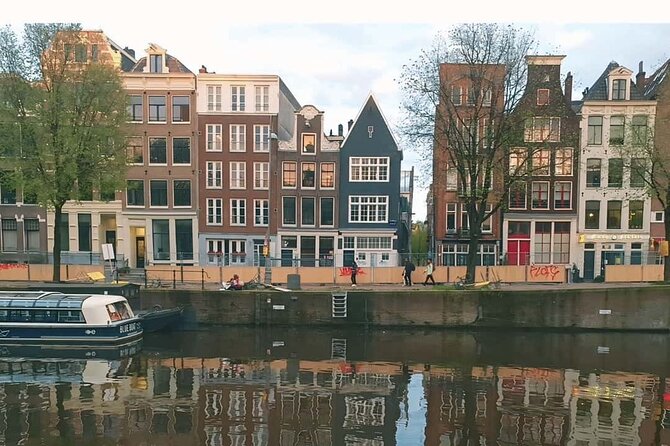
Reviewed · RED LIGHT DISTRICT
Amsterdam Red-light District Tour for Groups English or German
This Amsterdam Red-light District tour is interesting because it does the walk with context, not shock value. You trace the perimeter of the area, guided through how the city thinks about prostitution, legality, and everyday life, while still seeing classic streetscapes.
I like two things a lot. First, the tone stays respectful and explanatory, so you get real answers to real questions. Second, the route is more than adult-adjacent streets, it threads in Chinatown, Nieuwmarkt, and the Oude Kerk area so you understand why this neighborhood sits inside Amsterdam proper.
One possible drawback: the subject matter is inherently adult and can feel awkward if you prefer your city stories strictly light and fluffy.
Key things I’d watch for on this tour
- A local-guided, perimeter route focused on context, not gawking
- Sandro-style guiding energy: kind, engaging, and strong at handling questions
- Chinatown plus canals so you connect the neighborhood to wider Amsterdam geography
- Nieuwmarkt near the 16th-century wall area to anchor what you see in time
- Coffee shop stop for plain talk about what is legal and why coffee shops have that name
- A practical look at red-light rules including requirements for prostitution and how safety gets discussed
A 2-Hour Group Walk With Real Context, Not Rumors
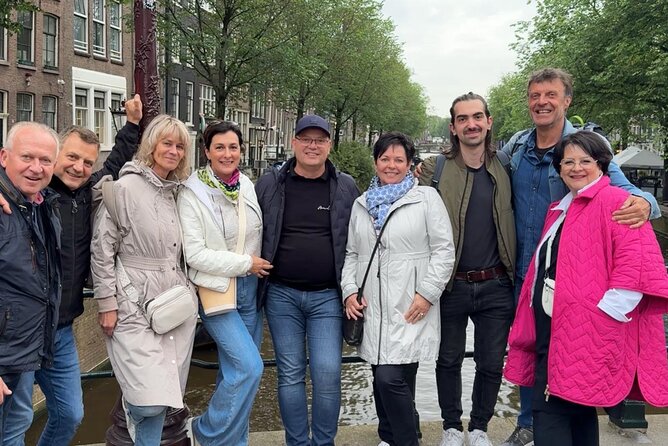
This is a 2-hour group tour that runs around the edges of Amsterdam’s Red-light District with an English or German guide. It is priced at about $30.13 per person, which for a guided walk is fairly solid if you care about understanding the place instead of just passing through it. The group size is capped at a maximum of 30 people, so you should still be able to hear, ask questions, and not feel swallowed by the crowd.
You get a mobile ticket, and the tour starts and ends at the same meeting point, the Basilica of Saint Nicholas on Prins Hendrikkade. It is also near public transportation, which matters in Amsterdam because you can hop between neighborhoods fast and avoid wasting time.
The big value here is attitude. This is not sold as a spectacle. It is framed as a story about how the city handles a sensitive topic, including the way Amsterdam is often described as progressive, direct, and organized. In practice, that means you spend less time on myths and more time on how systems work, who sets rules, and what the neighborhood looks like when you zoom out.
If you are the kind of person who likes to connect dots, this tour fits. If you want a purely sightseeing route, it may feel too serious for your mood on that day. You can still enjoy the Amsterdam sights, but the emotional temperature runs higher than a typical photo-walk.
More Red Light District walking tours:
- Amsterdam: Red Light District Tour in DE/EN/IT/ES/FR
★ 4.9 · 7,136 reviews - Amsterdam: Red Light Secrets Museum Entry Ticket
★ 4.2 · 5,722 reviews - Amsterdam Red Light District & Coffee Shop Tour
★ 4.6 · 4,134 reviews
Starting at Basilica of Saint Nicholas, Then Linking District and City
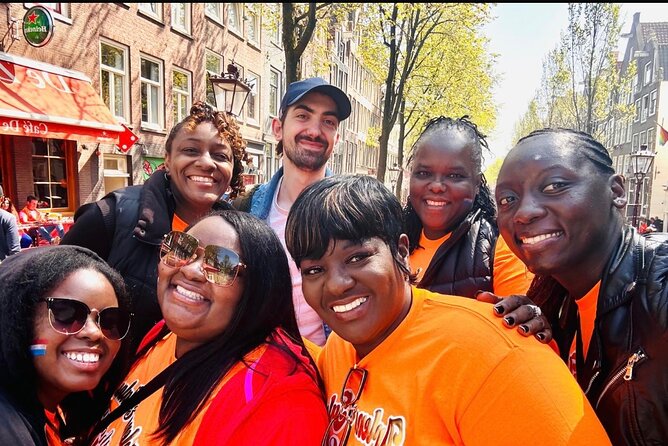
You begin at the Basilica of Saint Nicholas, right on Prins Hendrikkade. That location is useful because it gives you a clear starting anchor in the city, and you are not scrambling to find a random corner. It also sets the tone: this tour is grounded in Amsterdam streets, not inside a fantasy bubble.
From there, the route pulls you outward and inward at the same time. You pass through areas tied to Dutch history, trade routes, and changing neighborhoods. That is what makes the perimeter approach work. You get to see how the Red-light District is woven into regular Amsterdam life, with canals, older buildings, and street geometry doing their own quiet storytelling.
The early part is where you get your bearings. The guide explains what you are walking through, including why certain streets and buildings look the way they do. One highlight is the canal connection, including a discussion of how water relates to the crooked houses you notice across Amsterdam. Even if you think you already know Amsterdam’s canals, this kind of explanation helps you look again, slower.
This opening section also helps you mentally prepare. When a guide sets context early, you are more likely to handle the later stops calmly, with curiosity instead of discomfort.
Chinatown Footsteps and Canal Views You Might Skip on Your Own
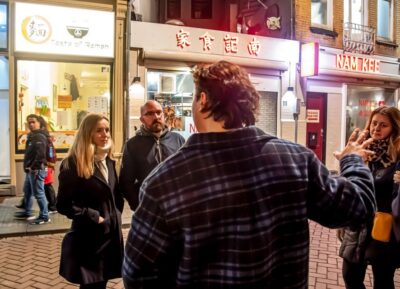
The first major stop on the walk is Amsterdam Chinatown, or what is left of it. You do not just zoom past signs. You get time to look at the canal views and talk about facts tied to the water and Amsterdam’s crooked houses. It sounds niche, but it is the kind of detail that makes a city feel lived-in and specific.
There is also a walk toward a temple area as part of this stretch. Even without it being a long sightseeing detour, it gives you variety. One moment you are reading the city’s layout through canals and façades, then you shift to a cultural landmark and the story around it.
What I like about bundling this with the Red-light District perimeter is that it stops the tour from becoming one-dimensional. You see a neighborhood layer that is connected to migration and commerce, and it reminds you that Amsterdam is a patchwork city. That matters because the Red-light District did not appear in a vacuum. It sits among other districts shaped by economics, housing, and changing communities.
A small consideration: if you were hoping for a full Chinatown visit with lots of time to eat or shop, this is not that. You are walking and learning, not spending a leisurely afternoon. Still, for 2 hours total, this stop is a smart way to broaden your view.
Nieuwmarkt and the Wall Area: A Quick Time Machine
Next you spend time near Nieuwmarkt, next to the protection wall from the 16th century. This is a short stop, but it is a good use of time because it grounds you. You are not only looking at streets that feel “old,” you are connecting them to an actual time marker.
Nieuwmarkt is one of those places that can feel like a convenient transit spot if you are rushing. On this tour, it becomes more than a crossroad. The guide’s framing helps you notice the area as part of Amsterdam’s fortification past, and then you start to understand how the city expanded and re-shaped itself around older boundaries.
For your trip planning, this is also useful. If you later wander in that area on your own, you will have a storyline in your head. You will know what you are seeing, at least at a basic level, which makes independent exploring easier.
The tradeoff is simple: because the tour is only about two hours, you do not linger long. Think of this as a taste, not a deep historical lecture.
A few other ways to fill a day in Amsterdam
- Amsterdam: Van Gogh Museum Ticket
★ 4.7 · 52,054 reviews - Amsterdam: Heineken Experience Ticket including 2 Drinks
★ 4.6 · 36,014 reviews - Amsterdam Classic Saloon Boat Cruise with Drinks and Cheese
★ 5.0 · 31,825 reviews - Amsterdam Luxury Canal Cruise + Unlimited Drinks & Bites option
★ 5.0 · 30,518 reviews
Coffee Shop Amsterdam Cafe: Dutch Drug Rules in Everyday Language
One of the more practical stops is in front of a coffee shop. Here you talk about the drug situation in the Netherlands, including what is legal and how coffee shops got their name. Then you visit a coffee shop to get a better look.
I appreciate this stop because it tackles the kind of question people always ask Amsterdam tours around the world. The point is not to turn it into a debate club or a moral lecture. It is to explain how the system works, why the language is what it is, and what you should understand when you see these places.
This is also a good reality check if you have preconceptions from your home country. Amsterdam has a reputation, but you need a local framework to make sense of it. A guide who can answer questions competently helps you avoid misinformation.
What about your comfort level? If you would rather keep the tour strictly non-drug, you might find the topic slightly uncomfortable. But the benefit is that you learn the rules so you are not guessing.
Also, the stop is built into the flow. It is not a random detour. It fits the wider theme of how Amsterdam handles sensitive topics with laws, labels, and day-to-day operations.
An Alleyway Stop Inside the Red-light District Perimeter
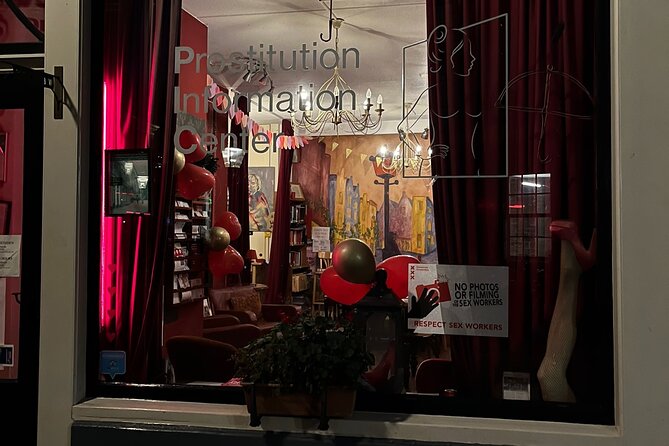
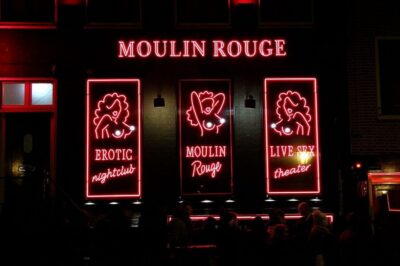
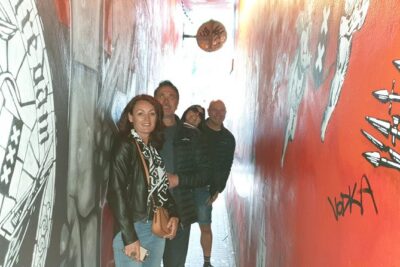
The heart of the tour comes when you enter one of the alleyways in the Red-light District area. This is where the tone matters. The goal here is not to stare. You get an insight into the conditions and you discuss topics like requirements for prostitution and who ensures safety.
Even with careful wording, it is still an adult topic. So plan your mindset. Go in with the understanding that this is about systems and rules, not entertainment. If you can handle that, you will get more from the tour.
This section is also where the best guides earn their money. In the feedback, Sandro is repeatedly praised for being kind, engaging, and especially good at answering questions. That matters because you might have concerns about how safety works, how the rules are described, or what visitors can and cannot do. A guide with good answers keeps the group calm and moving.
A practical note: alleyways can be tight and busy. Keep your expectations realistic. You are walking through a real neighborhood, not touring a set.
The Old Church Stop Before the Second Part of the District
Before you go into the second part of the Red-light District area, the tour stops in front of one of Amsterdam’s oldest buildings in the area, the old church. This is a clever reset in the itinerary. After a sensitive stretch, you get a moment of architectural and historical anchoring.
What you gain is perspective. The Red-light District is right next to landmarks that have been part of Amsterdam for centuries. That proximity is the point. It shows you that the neighborhood is not an isolated bubble. It is part of a city with deep layers, where religious buildings, civic spaces, and modern controversies all coexist in walking distance.
This stop also helps you take photos more thoughtfully. Instead of only snapping neon and windows, you can frame the bigger Amsterdam story, including older stone and street lines.
Again, time is limited. You are seeing the exterior and learning the significance, not doing a full church visit.
Why the Perimeter Route Works for First-Timers
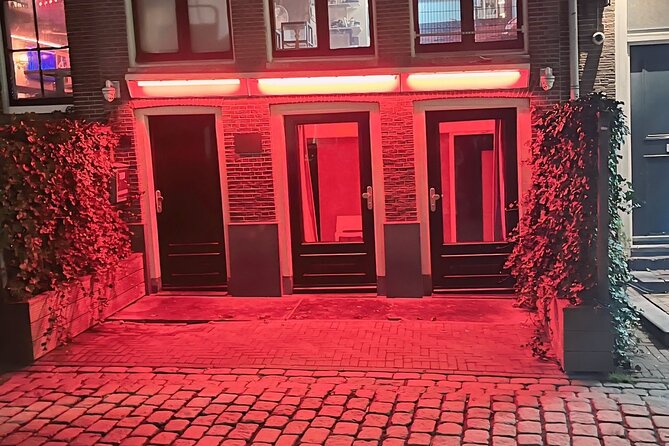
A perimeter tour is a smart format for most first-timers. You see enough to understand the neighborhood, but you are not trapped inside the busiest feel of it for the entire time. That makes it easier to keep your comfort and focus.
It also aligns with how Amsterdam actually operates. The city is built on neighborhoods you can walk through like chapters. When you link the Red-light District to Chinatown, Nieuwmarkt, canals, and the Oude Kerk area, you start to grasp the real layout of the city, not just the headline part.
Another underrated value is question time. The tour is designed so the guide can answer what you want to know. If you have concerns about safety, legality, or what is and is not allowed as a visitor, this kind of guided explanation helps you avoid awkward guessing.
And the humor helps. The feedback highlights wit in routing and presentation. That is important on a serious topic. A guide who can keep things human, not cold, makes it easier to learn without feeling judged.
Price and Logistics: Is It Good Value for Your Time?
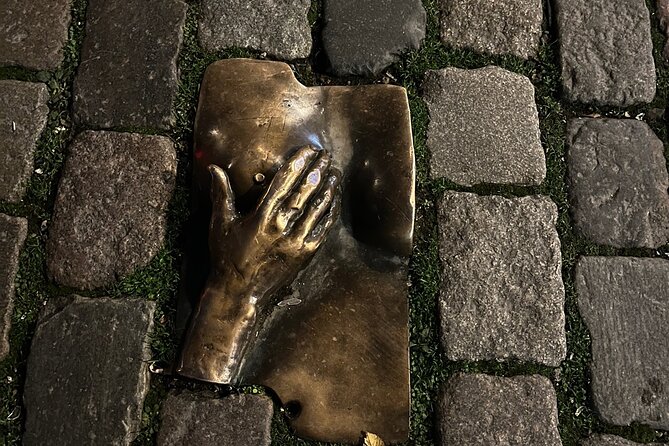
At $30.13 per person for roughly two hours, you are paying for three things: a local guide, a route that connects multiple parts of Amsterdam, and structured context for a sensitive area.
If you were to do this on your own, you might spend more time walking without learning the “why.” You could look up facts afterward, but the whole point of a tour is to get explanations in the moment, while you are standing where the story unfolded.
The logistics are also straightforward. It runs with a maximum of 30 people, starts at Basilica of Saint Nicholas (Prins Hendrikkade 73), uses a mobile ticket, and ends back where it starts. That makes it easier to plug into a day of sightseeing without complex planning.
If your schedule is tight, you’ll also like that the tour is commonly booked around 6 days in advance on average. Plan for that if you are traveling during peak season.
One more practical thought: because the tour is in a real working city area, expect normal street conditions. You are wearing shoes for cobblestones and walking, and you should dress for typical Amsterdam weather.
Who Should Book This, and Who Might Skip It
This tour is a strong match if you want:
- Context over shock on a sensitive topic
- A guided route that also includes major Amsterdam stops like Chinatown and Nieuwmarkt
- A guide who can answer questions clearly, with warmth and engagement like Sandro is known for
It might not be for you if:
- You get uncomfortable with adult subject matter, even when it is discussed respectfully
- You want a long, slow museum style experience rather than a quick guided walk
- You would prefer zero conversation about legal and safety rules
If you do book, choose a day when you can handle a slightly heavier theme and still enjoy walking. This is not only a history and culture story, it is also a reality check about how Amsterdam organizes sensitive parts of life.
Should You Book the Amsterdam Red-light District Tour?
I think it is worth booking if you want to understand Amsterdam beyond postcard clichés. The route is well built for first-timers: Chinatown canals for city texture, Nieuwmarkt for anchoring time, coffee shop talk for legal context, and then a careful explanation in the Red-light District perimeter.
If you are on the fence, here is the simple decision rule: book it if you prefer guided explanations and respectful context. Skip it if you want your trip to avoid adult topics altogether. Either way, you will come away seeing Amsterdam with clearer eyes, and that alone is a win.
FAQ
How long is the Amsterdam Red-light District group tour?
The tour lasts about 2 hours.
What languages are available?
The tour is offered in English or German.
Where does the tour start?
The meeting point is the Basilica of Saint Nicholas, Prins Hendrikkade 73, 1012 AE Amsterdam.
How many people are in the group?
This tour has a maximum of 30 travelers.
Do I need a paper ticket?
No, you will use a mobile ticket.
Is free cancellation available?
Yes. You can cancel for a full refund up to 24 hours in advance of the experience’s start time.
Are service animals allowed?
Yes, service animals are allowed on this tour.
Latest Amsterdam reviews
- Amsterdam Private Prosecco Bike with Music Sound System★ 5.0 · 3 reviews
- Private Day Trip From Amsterdam to Rotterdam and Zaanse Schans★ 3.5 · 3 reviews
- 1 hour Amsterdam City Tour in Pedicab★ 4.5 · 3 reviews
- The Best of Amsterdam: Private Full-Day Tour with a Canal Cruise★ 2.5 · 3 reviews
- Amsterdam Walking Tour with Audioguide on Your Smartphone★ 3.5 · 3 reviews
- Bike Tour with Guide in Amsterdam★ 4.5 · 3 reviews
- Concert at The Royal Concertgebouw – Amsterdam★ 5.0 · 3 reviews
- Private tour (max 3 per) to Giethoorn & Canal ride from Amsterdam★ 3.5 · 3 reviews
Red Light District, compared.
Amsterdam Red Light District & Coffee Shop Tour
Read our review →
Red Light District Pub Crawl with Unlimited Shots
Read our review →
Private Amsterdam Red Light District and Coffee Shop Tour
Read our review →
Browse the lists this tour appears in